How Rising Material Costs Are Reshaping Construction in Abu Dhabi
If you’ve worked on a building project in Abu Dhabi this year, you’ve seen it. A quote that looked fine in January is different by the time the purchase order goes out. Budgets signed off two years ago are being reopened, and everyone’s talking about money with a lot less polish.
At The Mob Construction, we’d rather be straight with you. Construction costs in Abu Dhabi have climbed in 2026, and you should know why

Abu Dhabi Is Building Like Never Before
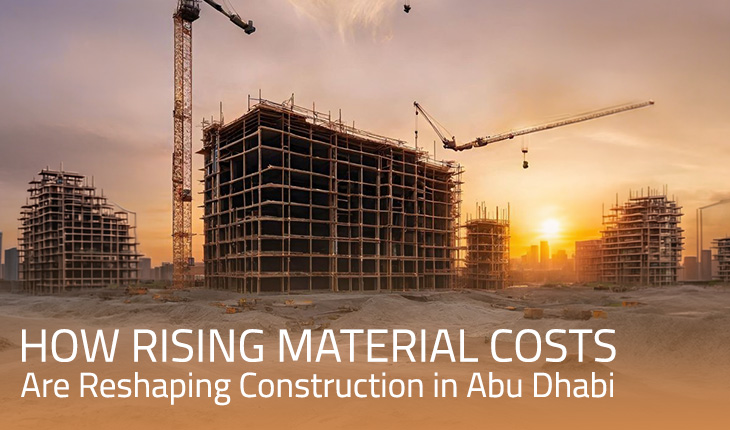
Abu Dhabi has a lot going up at once. Yas Island, Saadiyat Island, and Al Reem Island all have towers, hotels, and cultural projects underway, alongside a 150 km high-speed rail link to Dubai due by 2030, per Knight Frank. Nationally, S&P Global Ratings counts about $138 billion of confirmed UAE construction projects.
When that many sites are buying steel, cement, concrete, aluminum, glass, and electrical components in the same months, prices follow. It’s plain supply and demand, playing out in one of the Gulf’s busiest building markets.
So Why Are Prices Actually Going Up?
Demand is only part of the story.
Shipping is the first piece. Disruption around the Strait of Hormuz, along with continuing risk in the Red Sea, has pushed cargo onto longer routes and stretched delivery times. Moody’s Ratings says imported building materials in the UAE now cost 20 to 25 percent more than before the conflict. Concrete, steel, aluminum, and ceramics are mostly sourced locally and far less affected, so the pressure lands on imported items like MEP equipment, electrical components, and specialist finishes.
Energy is the second. Aluminum, glass, and steel take a lot of power to make, and Currie & Brown reports sharp global rises in oil, aluminum, and copper this year. Diesel has swung up and down since April. Manufacturers pass those swings on.
Then there’s steel. Emsteel’s Abu Dhabi rebar price sat at AED 2,660 per ton through much of 2025 and reached AED 2,728 delivered for April 2026 production. AESG puts the market price at AED 2,520 per tonne in the first quarter of 2026, up 6 percent from the previous quarter, and Currie & Brown has steel reinforcement up 8 percent since January. That’s a steady climb, not a spike. Add cement up 16 percent and concrete up 10 percent by August, and a budget looks very different.
What This Means on the Ground
Contractors on fixed-price contracts have had a hard year. If prices rise after signing, the contractor absorbs the gap, and margins on mid-size and large projects typically run only 8 to 12 percent. Moody’s says firms that locked in prices early are protected for now, but Currie & Brown reports more contractors refusing to hold fixed prices on long programs, with some steel quotes valid for around 30 days. Renegotiation isn’t bad faith. It’s arithmetic.
Developers feel it differently. Most 2026 and 2027 handovers are still on track, according to Moody’s, helped by stockpiles covering two to six months of key imported materials. The slippage shows up in specialist packages, where waits are longer, and extension-of-time claims are rising.
For buyers and investors, the effect is only starting to reach prices. Developers who locked in costs earlier have kept launch prices fairly steady, but that cushion fades as projects get repriced at current costs. Off-plan prices could rise as a result, although S&P expects Abu Dhabi’s tighter supply pipeline to support values. Waiting may cost more. Nobody can promise it will.
On the numbers, forecasts vary. S&P, citing Matthews’ Q3 2026 update, expects UAE building costs to rise 7 to 12 percent this year, against 1.8 percent in 2025. Arcadis is lower for Abu Dhabi at 3.5 to 4.5 percent through the end of 2026. Electrical materials in Abu Dhabi were up more than 14 percent year on year in the first quarter, according to AGBI.
The Market Is Stressed, Not Broken
Abu Dhabi is still in good shape. Moody’s found Abu Dhabi and Sharjah the most resilient UAE markets, helped by domestic buyers, and government-backed projects continue at scale. Arcadis ranks Abu Dhabi 69th worldwide on construction cost, well below London or Geneva, so it’s still a competitive place to build.
The market isn’t retreating. It’s adjusting. The developers and contractors coming through well are the ones who planned early, locked in pricing through longer agreements, sourced locally where they could, and gave clients realistic numbers from day one.
How We’re Navigating This at The Mob Constructions
We’ve changed how we plan and buy for every Abu Dhabi project. That means earlier material commitments, tighter scheduling, open cost conversations before anything breaks ground, and steady effort to cut waste without cutting quality.
Abu Dhabi is still one of the best places in the world to build. Doing it well right now takes more foresight and flexibility, and a team that understands the market as it is today. That’s what we bring to every project.